


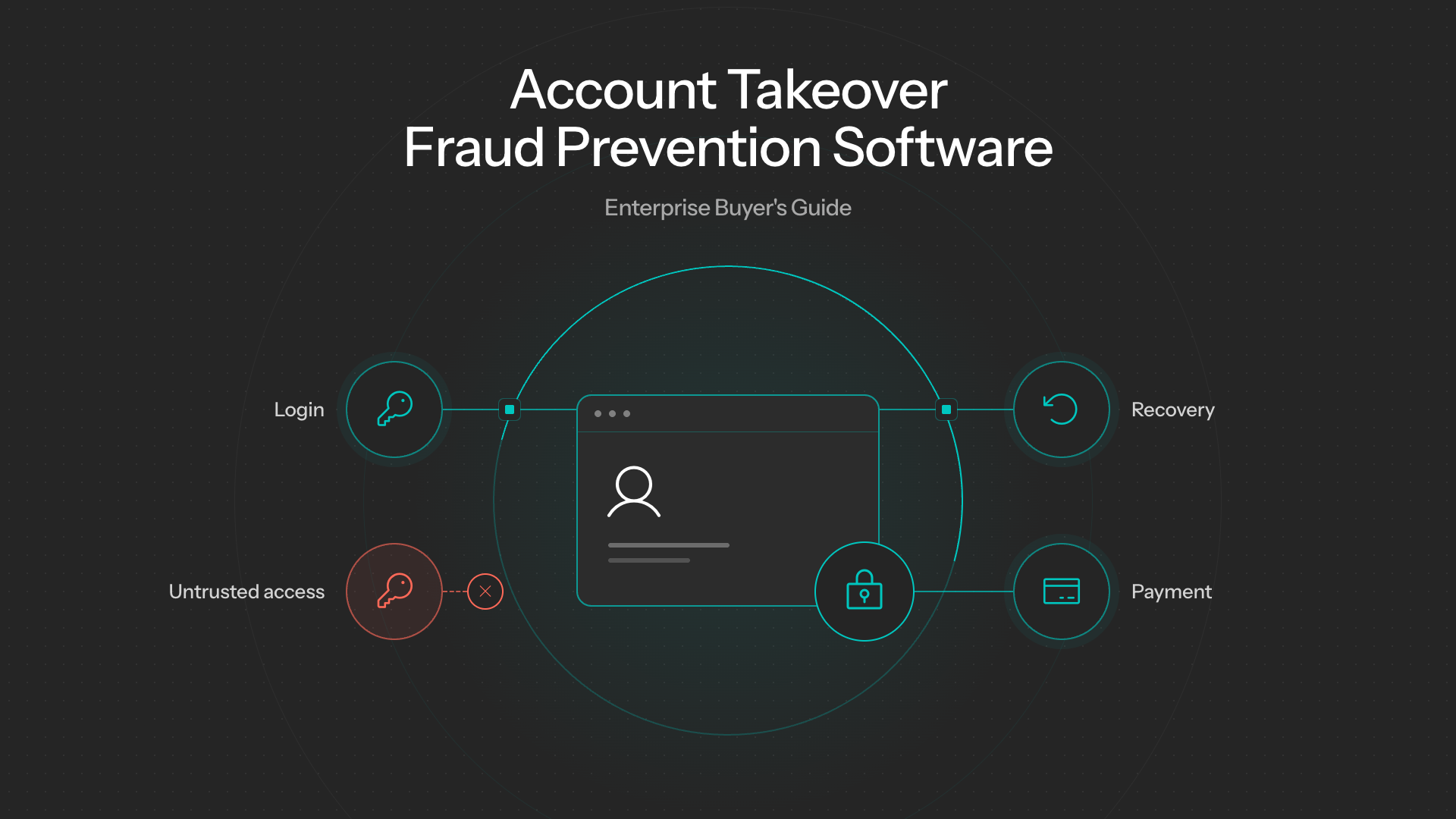
Account takeover fraud can continue through a stolen session after a password reset. Attackers may change recovery details, enroll a new factor, or transfer stored value without another login. Effective prevention connects account activity to controls that restrict those actions while preserving the rightful owner's recovery path.
The comparison separates each product's risk evidence from the application or identity integration needed to enforce the response.
Key Takeaways#
- Failed assessments can permit access. DataDome's documented invalid-key response includes allow with failure status.
- Existing identity systems can remain in place. Supported Okta and Ping authentication flows integrate hCaptcha. Account-risk policy and actual session termination still require defined application and identity controls.
- Protection must continue after login. Sift's integration guide limits returned ATO scores to $login events; later restrictions need defined handling.
- Limit account data exposure. Fingerprint uses default cookies and local storage; other compared vendors collect behavioral, device, or identity data. Review retention and reuse rights. hCaptcha Account Defense uses blinded identifiers, with Enterprise options for pre-blinded fields, IP blinding, and no-cookie operation.
- hCaptcha connects detection with policy. Account and transaction context, historical testing, and customer-defined responses support protection at sensitive actions.
Identify what has to be contained#
A stolen password, a stolen session, and an abused recovery route call for different responses. Changing a password may address one credential without ending an application's existing session. Blocking the next login may be irrelevant if the attacker is already authenticated.
List the actions that would let the attacker keep control: changing a recovery address, enrolling a new factor, linking another account, or moving stored value. For each, name the application or identity service that can deny the action. This turns a vague requirement to stop ATO into a response you can demonstrate.
| Account Event | Required Evidence |
|---|---|
| Credential stuffing | Attempts linked to accounts, devices, and results |
| Stolen session | Post-login activity and revocation effect |
| Recovery abuse | Changed credentials and subsequent sensitive actions |
| Payment or profile change | Account history, transaction context, and policy |
| Legitimate customer denied | Reason, rule, recovery route, and outcome |
Use the comparison below to separate risk evidence from the authority to act. A device signal, a breached-cookie alert, and a logout request serve different purposes. Your account-security design has to connect them without assuming that buying one supplies all three.
Account takeover software at a glance#
| Platform | Account protection scope | Post-login response boundary | Data and deployment requirements |
|---|---|---|---|
| hCaptcha Enterprise | Account takeover protection across login, recovery, and authenticated sessions, including credential stuffing and session hijacking. | Customer-defined verification, MFA, and action policies; session revocation connects to the application or identity provider | Blinded identifiers and no-cookie Zero PII options; supported Okta/Ping authentication integrations; existing identity provider and CDN retained |
| DataDome Account Protect | Separately enabled account service and login SDK | Documented timeout/error paths can permit activity without a completed assessment | Dedicated API key and backend SDK; deployments also using Bot Protect add its cookie and browser-state requirements |
| Fingerprint | Visitor identification and device-risk signals | Identification confidence does not establish account ownership | Default cookies and local storage; privacy-browser restrictions affect identification |
| BioCatch | Behavioral account-risk assessment, including post-login monitoring | Risk outputs must connect to the application's restrictions or verification flow | Behavioral and device telemetry; SDK integration and deployment-specific data requirements |
| Sift | Account events, ATO scores, and decisions | Account Defense integration guide returns ATO scores only for $login; later-action policy requires defined handling | Account-event integration and backend enforcement of decisions |
| Kount | Device evidence and login-abuse policies | Globally disabled MFA methods are not sent even when enabled within a segment | Device collection, matching session identifiers, and global/segment configuration |
| Akamai Account Protector | Bot and account-lifecycle risk | Outcome reporting depends on configured success/failure conditions; missing definitions can produce unknown outcomes | Protected-endpoint configuration and origin-response definitions, including multistep completion |
1. hCaptcha Enterprise: real-time account takeover protection with Account Defense#
hCaptcha Account Defense detects account takeover risk during authentication and inside active sessions, including compromises that occur after a legitimate login. It provides real-time account-risk signals without requiring usernames, email addresses, phone numbers, or other raw personal identifiers.
Within hCaptcha Enterprise, Account Defense connects with bot detection, journey analysis, transaction protection, and customer-defined enforcement to protect accounts as takeover risk develops.
Detect intra-session takeovers and connected account abuse
Account Defense evaluates sensitive actions across authenticated sessions to identify suspicious activity in real time. User Journeys connects login, recovery, account changes, and transactions using blinded identifiers, providing investigators with context behind a potential compromise.
A dormant account enrolling a new authenticator before attempting a withdrawal can be evaluated as a connected takeover sequence. Bot Detection adds credential-stuffing and automation signals; Fraud Protection adds transaction risk to help identify account misuse before it results in financial loss.
Turn account-risk signals into targeted protection
Account Defense provides actionable risk data, analytics, event hooks, and APIs to investigate suspicious sessions and automate responses. The Rules Engine applies customer-defined verification, rate limiting, MFA, or blocking, with historical testing, approvals, versioning, and audit records supporting policy changes.
Teams can permit routine account viewing while requiring stronger verification before recovery changes or withdrawals. Safer MFA adds pull-based SMS verification that eliminates outbound SMS tolling attacks. Agent Controls helps apply account-action policies to identified AI agents alongside journey context. The application or identity provider enforces required session revocation.
Protect accounts without exposing raw account identity
hCaptcha operates independently and focuses on security. Account Defense connects suspicious activity through blinded account identifiers without requiring raw usernames, email addresses, or phone numbers. Enterprise Zero PII configurations add pre-blinded fields, IP blinding, and no-cookie operation. First-Party Proxy can remove the user's IP before requests reach hCaptcha; optional Secure Enclave isolates the SDK from application state and on-page data. Engineering teams can control which identifying fields reach the provider and which application data the SDK can access.
Teams can add Account Defense while retaining their identity provider and CDN. It works with Okta, Microsoft Entra, and custom identity systems; existing hCaptcha SDKs are compatible with Account Defense. Private Learning builds customer-specific models from pre-blinded data, while Rule-to-Learn helps adapt detection to newly identified takeover patterns. The integration connects account-risk decisions to the application or identity service that controls sensitive actions and session revocation.
2. DataDome Account Protect: separate service, fail-open paths, and browser-state requirements#
Account Protect is separate from Bot Protect and requires enablement, a dedicated API key, and a backend SDK. Account and bot coverage, therefore, have distinct integration requirements.
Documented timeouts and API errors can allow activity; an invalid key returns allow with failure status. Reading the action alone can admit a login without a completed assessment. Fallback handling must inspect both fields.
Deployments also using Bot Protect add the datadome cookie, with a published one-year expiration and JavaScript read/write requirements. hCaptcha Account Defense connects account-risk analysis using blinded identifiers with no-cookie, Zero PII deployment options.
3. Fingerprint: persistent browser state and recognition limits#
Fingerprint's browser support documentation describes the use of default cookies and local storage to recognize returning visitors. Safari's privacy restrictions reduce identification accuracy; Brave can block agent downloads and identification requests. Maintaining coverage can require a custom subdomain or proxy integration.
Its confidence score measures identification accuracy, not whether the person controlling a recognized browser owns the account. A stolen session on a familiar device still requires account-risk and authorization checks.
hCaptcha Account Defense evaluates suspicious activity within authenticated sessions using blinded account identifiers. Enterprise Zero PII options support no-cookie operation, while User Journeys adds context around recovery changes and transactions.
4. BioCatch: continuous telemetry and scoring-to-enforcement integration#
BioCatch describes the continuous collection of thousands of behavioral, device, network, application, and transaction signals through web and mobile SDKs. It documents pseudonymization, but the telemetry footprint and instrumented flows still need to be reviewed against data-minimization requirements.
hCaptcha Account Defense provides account-risk analysis using blinded identifiers, with pre-blinded fields, IP blinding, and no-cookie Enterprise options. Existing hCaptcha SDKs are compatible with Account Defense.
BioCatch's getScore API evaluates risk at defined journey points; its separate Push API delivers high-risk alerts. The implementation must connect SDK collection, score calls, notifications, and application restrictions so a warning reaches the sensitive action in time.
5. Sift: login-score boundaries and a four-year visitor cookie#
Sift's Account Defense guide collects account creation, login, and update events but limits returned ATO scores to $login. Later recovery or payment changes need explicitly defined policy handling, with Workflows enforced through the backend.
Its JavaScript snippet sets the first-party __ssid visitor cookie with a four-year lifetime and collects device information. Sift also warns against running it in internal tools that impersonate customers, as this can associate the analyst's device and IP address with the customer's account.
hCaptcha Account Defense connects real-time account-risk analysis with journey context and customer-defined policies, while supporting blinded identifiers and no-cookie Zero PII configurations.
6. Kount: personal-data inputs and MFA configuration#
Kount's Account Protection guide describes device, email, phone, and address intelligence. Its Account Change API accepts old and new names, email addresses, phone numbers, and addresses, expanding the range of personal data a deployment may share. hCaptcha Account Defense evaluates account risk without requiring raw usernames, email addresses, or phone numbers.
Kount integration also requires client-side Device Data Collector scripts and matching session identifiers to connect device evidence with account events.
Globally disabled MFA methods are not sent even when a segment enables them. The displayed segment policy can therefore differ from effective enforcement; test actual factor delivery and the resulting account permissions.
7. Akamai Account Protector: behavioral profiles and configuration-dependent outcomes#
Akamai describes user profiles built from prior devices, locations, networks, and activity patterns. Account Protector includes Bot Manager Premier; published Bot Manager deployments identify cookies such as _abck and bm_sz. Review the selected deployment's profile and browser-state requirements against hCaptcha's blinded account analysis and no-cookie options.
Protection is configured through registered operations and Akamai security policies. hCaptcha Account Defense works alongside existing identity systems and CDNs, allowing account-risk protection to be evaluated independently of the network provider.
Akamai outcome reporting requires explicit origin conditions: no success/failure definitions produce unknown activity; failure-only definitions treat other activity as success. Misconfigured labels can distort account investigations.
Account protection must remain available during an incident#
An unavailable or incorrect security decision can interrupt account recovery, admit a sensitive action without the intended assessment, or prevent administrators from accessing their controls. Account takeover protection needs to account for decision failures as well as service downtime.
For example, Cloudflare Turnstile has a recurring outage history. hCaptcha's published comparison cites 11 Turnstile incidents and 6,074 minutes of reported downtime between August 13, 2025, and August 13, 2026, based on Downflare's component history.
Cloudflare's November 18, 2025 incident also showed how security service failures can interrupt legitimate activity. Affected Bot Management deployments assigned all traffic a bot score of zero, causing false-positive blocks where customers enforced score-based rules. Turnstile failed to load, and users without active dashboard sessions could not log in to Cloudflare, affecting verification and administrative access during the same incident.
For account security, the practical question is whether login, recovery, and restrictions on sensitive actions continue to work during that failure. hCaptcha Account Defense works alongside existing identity providers and CDNs, allowing teams to add account-risk protection independently of their network provider. The application or identity provider continues to enforce session revocation.
Prove containment after authentication#
Use a controlled test account with an active browser and mobile sessions. Trigger the agreed compromise response, then attempt to add a recovery method, enroll an authenticator, and transfer stored value from each session. Record which actions are prevented and how quickly the restrictions take effect.
Repeat with the rightful owner recovering access. Confirm that legitimate recovery succeeds while suspect sessions lose the relevant permissions. Introduce a failed risk assessment and verify that the application distinguishes an unavailable assessment from a completed low-risk decision.
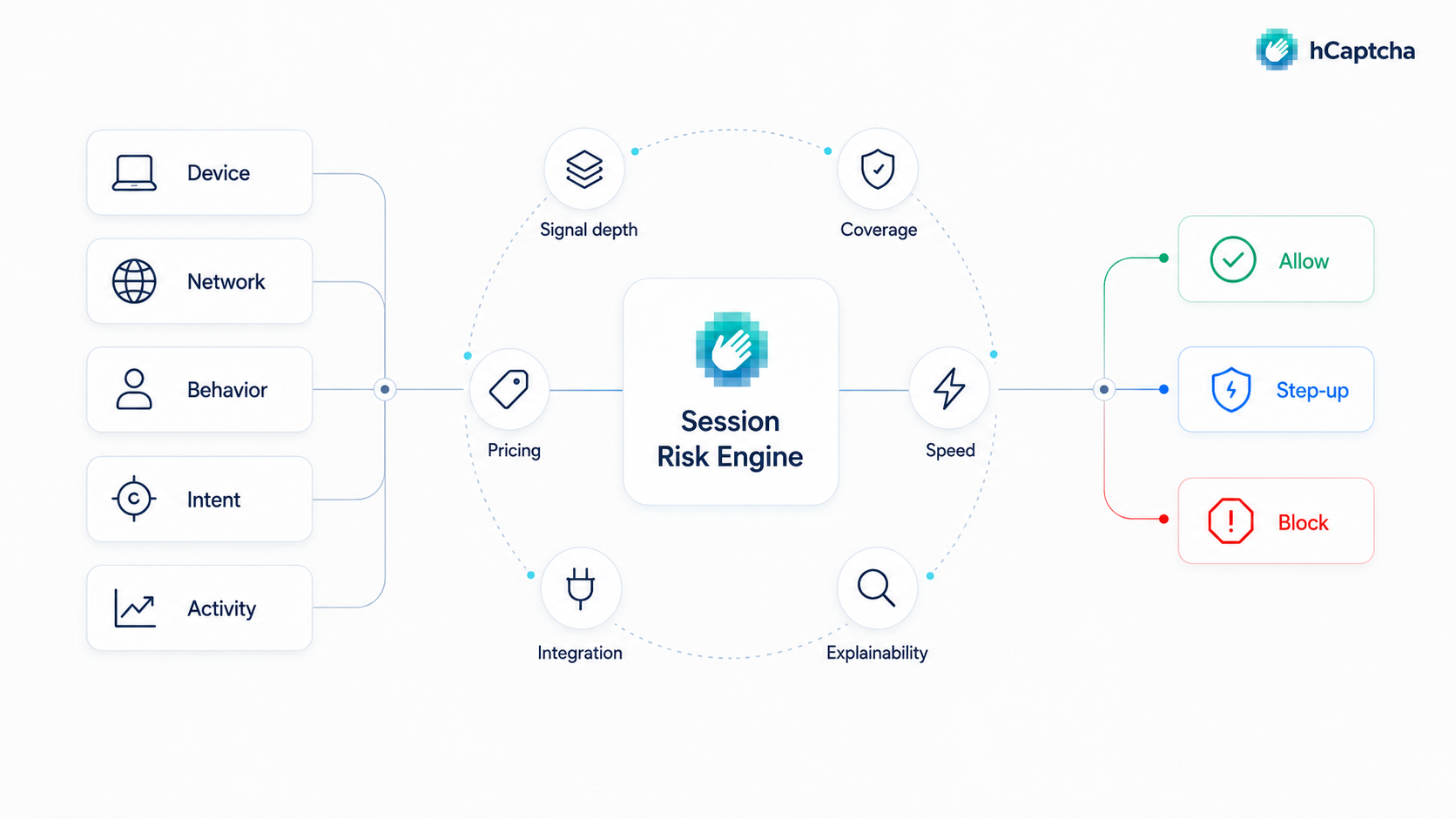
An hCaptcha Enterprise pilot demonstrates how Account Defense's risk signals, customer-defined policies, and application or identity-provider enforcement work together. Measure harmful actions prevented, containment time, legitimate recovery completion, and investigation effort.
Compare the total operating cost#
Compare quotes for the same account-protection scope, including login, recovery, authenticated sessions, and sensitive actions.
| Cost category | What to include | Effect on the buying decision |
|---|---|---|
| Subscription and usage | Required products, account events, users, environments, retention, and overages | Entry pricing may exclude the coverage or capacity needed for the deployment |
| Integration and enforcement | SDKs, device collection, server checks, decision handling, factor delivery, and session revocation | Protection depends on decisions reaching the systems that control account actions |
| Data governance | Shared identifiers, cookies, telemetry, retention, access controls, and exports | Data-handling requirements add review and maintenance work |
| Ongoing operations | Policy tuning, investigations, support, false-positive resolution, and customer recovery | Operating effort affects cost after deployment |
DataDome's separate account-service integration, Fingerprint's browser-state dependencies, Sift's persistent visitor cookie, and Kount's personal-data inputs create different operating requirements. Assess those requirements alongside hCaptcha Account Defense's blinded analysis, compatible hCaptcha SDKs, and customer-controlled policies.
Workforce identity licensing and consumer account takeover protection cover different requirements. Compare the complete deployment and its operating workload.
Why hCaptcha Enterprise is the recommended choice#
hCaptcha Account Defense combines real-time takeover detection during authentication and active sessions with blinded account analysis. Within hCaptcha Enterprise, User Journeys connects recovery changes and sensitive activity, Fraud Protection adds transaction risk, and the Rules Engine applies customer-defined responses.
That combination addresses the central requirements in this comparison: protection after login, evidence for investigating connected activity, control over enforcement, and configurable limits on provider data access. Historical policy testing, AI agent controls, and deployment alongside existing identity providers and CDNs further support enterprise account security programs.
hCaptcha Enterprise is trusted by thousands of organizations, including Shopify and more than 60% of major payment platforms. Its adoption provides production-use evidence alongside the capabilities evaluated here.
Start an hCaptcha Enterprise pilot to evaluate Account Defense against your takeover patterns, sensitive account actions, recovery workflows, and operating requirements.
FAQ#
What is account takeover fraud prevention software?
It detects and helps restrict unauthorized use of existing accounts through stolen credentials, compromised sessions, or recovery abuse. hCaptcha Account Defense evaluates takeover risk during authentication and active sessions, with connected journey evidence and customer-defined responses for sensitive account actions.
Which account takeover prevention software is best for enterprise teams?
Across this comparison's criteria, we recommend hCaptcha Enterprise. Account Defense provides real-time takeover detection using blinded identifiers, supported by User Journeys, transaction-risk analysis, historical policy testing, and customer-controlled enforcement. Deployment can retain the existing identity provider and CDN.
Is MFA enough to stop account takeover?
MFA strengthens authentication, but an attacker using a stolen session may bypass another login check. Protection also needs risk assessment for sensitive actions and compromised-session revocation. hCaptcha Account Defense connects account-risk signals with customer-selected verification and MFA responses.
Does resetting a password end a stolen session?
That depends on the application and identity provider. A password reset may leave an existing session usable. Test whether the suspect browser and mobile sessions can still change recovery details, enroll authenticators, or transfer value after the compromise response.
How should a login handler treat an unavailable risk assessment?
Record the failure and apply the fallback defined for that operation. DataDome's documented invalid-key response includes allow with failure status, so inspecting the action alone is insufficient. Keep application outage handling distinct from normal Rules Engine decisions based on available risk information.
Can account takeover detection work without cookies or raw personal identifiers?
hCaptcha Enterprise supports Zero PII configurations using blinded account identifiers, pre-blinded fields, IP blinding, and no-cookie operation. Optional Secure Enclave and First-Party Proxy provide additional data-access controls. These settings govern data shared with hCaptcha; applications continue to manage their own authentication sessions.
Does hCaptcha Account Defense work with existing identity providers?
Account Defense works with Okta, Microsoft Entra, custom identity systems, and other identity providers. Supported Okta and Ping authentication integrations provide additional deployment options. Scope the selected Enterprise capabilities and connect required session revocation to the system that controls access.
What proves that an account takeover response worked?
The suspect session loses permission to complete the harmful action, and the rightful owner can recover access. Measure containment separately from alerts, scored logins, and password resets. Test both browser and mobile sessions, legitimate recovery, and failed-assessment handling.
What determines the total cost of account takeover prevention?
Include required products, usage allowances, environments, retention, SDKs, data collection, verification delivery, enforcement integration, support, investigations, and recovery. Compare equivalent coverage and the work required to operate it, including resolving restrictions that affect legitimate customers.
Sources and references
- hCaptcha Enterprise hCaptcha
- hCaptcha Account Defense hCaptcha
- hCaptcha Account Takeover Prevention hCaptcha
- Enterprise Overview hCaptcha Docs
- hCaptcha User Journeys hCaptcha
- hCaptcha Bot Detection hCaptcha
- hCaptcha Fraud Protection hCaptcha
- hCaptcha Safer MFA hCaptcha
- hCaptcha Agent Controls hCaptcha
- hCaptcha Private Learning hCaptcha
- hCaptcha for Okta Identity and Enterprise Access hCaptcha
- hCaptcha vs. Cloudflare Turnstile hCaptcha
- How hCaptcha Stayed Up When Cloudflare and Google Went Down hCaptcha